a blog by Peter Leonard


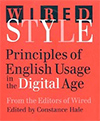 Wired Style: Principles of English Usage in the Digital Age
(San Francisco: HardWired, 1996)
Wired Style sat on my bookshelf unread from 1998 to 2006, surviving a trip from New York City to Seattle in 2003. This week, an assignment in English class (Language Ideology, Nation, and History) spurred me to open it for the first time. The book is of unmistakable West Coast origin itself, emerging from the San Francisco offices of Wired magazine, and more specifically from the self-conscious language register which characterized both the staff and the freelance writers of that magazine during its early years (1993-1996). Though most infamous for its visual design, the magazine also drew attention for the “way new journalism†it practiced: an attempt to update Tom Wolfe’s manifesto twenty years later. True to form, this 1996 style guide is distinctive both visually (black text on fluorescent green paper) as well as linguistically: it is an attempt to codify the way that savvy writers should explain the digital revolution in its early stages.
Nothing dates so quickly as yesterday’s tomorrow, and it’s not surprising that the book’s relevancy to modern questions of style and usage has faded faster than its arresting red cover in the years it sat exposed to time. The vast majority of this curiously-organized reference work consists of alphabetical lists of acronyms, technological terms, and what were once neologisms (website, email). Of mostly historical interest is the extensive discussion of such onetime shibboleths as Email/E-mail/e-mail/email, the proper treatment of the @ sign, and the admonitions against hyphenating URLs. Likewise trapped in amber are the helpful explanations of those protocols which preceded the web and were largely obsoleted by it: Gopher, WAIS, Telnet. The overall impression given is how diverse and polymorphous the online world was, before web browsers and websites won over a popular audience. Before the New York Times’ weekly Circuits section, before cable channels dedicated to gadgets and technology, Wired Style was an attempt to map out the landscape of what might be the next big thing, before it actually happened.
Confusingly, the book’s lists of terms and acronyms are subdivided into chapters with their own alphabetical order, leaving the user clueless as to where his or her questionable term might be. The chapter titles themselves do more to communicate the book’s ethos than its organization: “Transcend the Technical,†“Capture the Colloquial,†“Screw the Rules†and “Grok the Media.†Although these chapter divisions make the practice of looking up a word or phrase an exercise in frustration, they at least provide the authors with a chance to expound upon their theories of written communication in the digital age. It is in these chapter introductions that the real value of the book lies: not its botany of vintage chipset abbreviations, but instead its espousal of that strange blend of techno-triumphalism and counter-culture credibility which made Wired so memorable.
The worship of technology, or at least the ascription of transformative power to it, manifests itself at a number of levels. Primary amongst these is the admonition to avoid a general, non-technical language register and instead, in the words of one of the chapters, “Be Elite.†“[W]e write for a reader who shares a body of knowledge about the digital age — its timeline and history and cast of characters.†(13) This “narrowcasting†performs, of course, a dual function, only part of which Wired Style acknowledges. The obvious function is to attract those readers for whom ANSI, NCSA and IEEE are meaningful entities, rather than random letters. But the secondary function is to attract those readers who want to understand and use those abbreviations, even if they do not presently. That this ‘aspirational’ readership exists, and in fact is crucial for the magazine’s success, is obvious through an analysis of the advertisements in Wired since its inception. Rather than exclusively products and services aimed at those who already consider themselves ‘digeriati,’ many (if not most) of the ads are aimed those who feel they have to catch up to a revolution that passed them by. What Wired describes as “our cultural literacy†(emphasis in original) is in fact an artful rhetoric which reënforces an imagined in-group to which outsiders can gain access through reading (and perhaps writing) a certain style. (14)
Alongside this technophilia resides, as noted above, a pronounced affection for informality and a reaction against stuffiness. Wired Style explains this as an influence from that quantum of online communication: email. “[E]mail is pushing prose in new directions. So is the fleet discourse of newsgroups, online conferences, and threaded discussions on the Web,†the guide explains. (9) Writing, according to Wired, must change to reflect the “brevity, direct declarative sentences, and a high signal-to-noise ratio†of these new electronic media. Of course, every style guide from the New York Times’ to Strunk and White promotes this same simple, powerful style, and nearly every style guide seems to think it is unique in such espousal. Arguably, the limitations of telegram technology and column inches tightened journalistic English far more than email ever did or will. Nevertheless, the emphasis on (imagined) novelty gives the writers of the guide a target to aim at: “At Wired, we celebrate writing that jacks us in to the soul of a new society.†(5)
Somewhat contradicting this emphasis on brevity and simplicity, Wired Style promotes ‘authorial voice’ to a large degree — although perhaps no more so than other magazines with prominent freelance writers, such as The Atlantic or The New Yorker. In a chapter entitled “Voice is Paramount,†the guide decries the “oh-so-conventional voice of standard written English†as much as the “data-drowned voice of computer trade journals†and the “puréed voice of mainstream newspapers and newsmagazines.†(5) Their model is the “quirky, individualist spirit of the Net,†found in writers often known for their science-fiction prose, such as Bruce Sterling, Douglas Coupland and Neal Stephenson. These writers revel in a kind of ersatz Hunter Thompsonian over-the-top style, parasitic on the ‘gonzo’ journalism of the past at the same time it loudly proclaims its newness. There was a moment in the 1990s when it seemed like the future might well belong to “hippie-dissident-tribal-shaman-poet-heavy dudes†(Bruce Sterling, quoted on page 7), and that moment’s time capsule is Wired Style.