Cell Phone Video

| 1 Comment

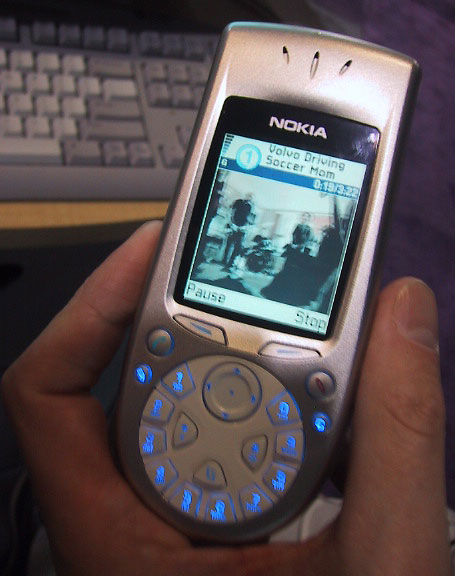
Several vendors, from Real to Sun, were showcasing video on cell phones this year at NAB. There are a number of components which have to come together at both hardware, software, and data transmission levels, for this idea to become a reality, and they probably aren't all there yet. Still, this year was the first that vendors were showing actual working models, so who knows what will happen in the next twelve months.

Working backwards, the first thing that has to happen for video on a cell phone is color screens. These are appearing on the market at many different price points currently, from SonyEricsson's premium offerings to Samsung's more entry-level devices. Unfortunately, nobody has standardized a bit depth or even screen size for color cell phone displays, so the market is pretty fragmented. The Ericsson P800, with it's large, PDA-size screen, shares shelf space with the same company's T68i, which sports a much smaller viewing area - one probably too small for recognizable video of any sort. So a color screen does not neccesarily a Watchman make.

The other question is one of codecs. Real has versions of its RealOne player for certain devices, including the Palm Tungsten, WinCE devices and certain Cell/PDA hybrids based on the Symbian OS. Their approach leverages the large existing base of RealVideo content - given a large enough screen and enough bandwidth, nearly any RealVideo G2, 8, 9, etc clip will play back. Unfortunately, they do not as of yet support any phones with Java alone - their Nokia solutions utilize the Sybian API rather than the Java/Brew API. (Somebody correct me if I'm wrong here - it's tough finding a booth rep who knows the nitty-gritty details of these things.)

In addition, their Palm support is currently only for the Tungsten, not the Sony CLIE series. This is a shame since Sony has been shipping color Palm devices, with full audio stacks, for years before Palm got their act together. It's precisely the foot-dragging by the Palm mother company, plus the delayed release of PalmOS 5's system-level support for color, high-res screens, and audio, which I always thought would threaten Palm's competitiveness in the multimedia area, and sure enough the PalmOS ecosystem is now divided into OS 4, OS 5, hacks onto OS 4 to support 5-only features, etc. But I digress.

Since Real's solution is based around the RealOne player idea, you can bet that every single piece of that software will show up on your phone - for better or worse. I sat through a Real presentation, aimed at content developers, which promised that users' eyeballs would be spammed with constant promotions of their content through the mobile version of the advertisements and content promos that have plagued Real's software players ever since the days of Take5, and have continued all the way up to the present-day "Content Panel" that hangs out on the lefthand side of of the player unless you disable it. I believe Real when they say that the key to audience building is promotion of audio/video content, but the reason why they think that should take place within the player window, instead of well-targetted advertisements on regular websites, eludes me.

Viable competitor to Real in this market space are Microsoft's WMV and the emerging MPEG-4 standard. Microsoft's solution is pretty cut-and-dried - a scaled-down version of their Windows Media player runs on most modern WinCE devices, and supports any and all codecs up to the limit of the CPU of the device. Since cell phones based on the WinCE OS are a pretty negligable market, and full-fledged PDA's with data capabilities are outside the scope of this piece, I'll just leave it at that, with the side note that given Microsoft's unwillingness to port the WMP to platforms such as Symbian, Palm and Java/Brew, I'm not sure how important they'll be in the cellphone video market.

A more credible competitor would be the emerging MPEG-4 technology. Since there is no one company behind this standard, it's hard to go to one booth at NAB and see soup-to-nuts solutions demostrated. Suffice it to say that, given adequate processing power, MPEG-4 decoding could be ported trivially to Java/Brew-based phones, and that for corporations that plan to standardize on that video format, transcoding a lower-bandwidth version of their content for cell phones would be relatively trivial.

The next duck that has to get into a row is the issue of transmission mechanism. If we're dealing with streaming video, the picture has to stream over some sort of protocol robust enough to ensure a constant bitrate, as well as have a high-enough bandwidth to at least meet the minimum standard of 56kbps - pretty much the lowest-bitrate at which videos are watchable with any codec. GSM is the world-wide standard here, and growing in the United States. The protocol you'd want to use to ensure high-bandwidth connection with GSM is something called GPRS - General Packet Radio Service. Cell phones can have anywhere from one to eight "downstream" timeslots, as well as at least one "upstream" timeslot. (My Ericsson T39 is 3/1, I believe). The more timeslots you have, the more bandwidth you get as they are multiplexed together, up to a theoretical maximum of 170kbps. Data transmitted this way is usually billed at the $/bit level, rather than the $/minute usually associated with GSM data calls.

The other alternative is HSCSD (High speed circuit swiched data). This is a more evolutionary extension of traditional GSM data transmission technology, rather than the exotic pay-per-bit, multi-channel revolution that GPRS represents. HSCSD works by gluing together individual 14.4kps GSM data timeslots into a theoretical bandwith of 56kpbs. Since it is circuit-switched, it can theoretically offer a guarenteed quality-of-service level, which is important for applications such as streaming video. On the other hand, it is far less flexible and adaptable to congested network conditions as the packet-based GPRS, and the maximum bandwidth is much lower.

Nokia's Symbian-based phones, including the large clamshell designs all use HSCSD, as opposed to GPRS. Ericsson, on the other hand, has been quick to embrace GPRS instead, and many industry observers see the latter technology winning out as the mainstream solution.

Finally, a note on the usefullness (or lack thereof) of this whole market segment. As one anonymous booth staffer pointed out, given the limited bandwidth and high per-bit charges associated with GPRS in the USA, how many people can be expected to get excited about downloading a music video or audio clip for the equivalent of $5 in data charges? Clearly many things have to change for video on cell phones to become anything more than a technical capbility in search of a business problem. Some innovative solutions that leverage existing technologies are being proposed - perhaps a SMS message sent to subscribers when a grand slam home run happens in a game involving one of their favorite teams. Included with the SMS is a thumbnail picture as well as a hyperlink to a 20-second video clip, which is streamable for a 50¢ fee. It is probably through approachs such as these, rather than an attempt to recreate the world of desktop streaming video on a 1×2 in. screen, that video on cell phones will flourish.

No TrackBacks

TrackBack URL: http://www.thegogglesdonothing.com/mt/mt-tb.cgi/49

1 Comment

I was able to try out NTT Docomo's video phones at a demo lab in midtown NY recently. It works okay, but I don't think it's marketable. They said that after a year in Japan, only about 100K are using it out of their user base of tens of millions. That's a pretty tiny fraction.

The problem is that it's too expensive for casual users, and too blurry for professional users. They quoted about $1 per minute for some very small screen (320x240, 10FPS) video.

The big question is what is the marginal value of video over say still images (and what's the value of that over simple audio.) Video's marginal advantage is only the ability to show motion. That's a very limited set of cirumstances where it is really useful. NTT Docomo says architects love the video... but I question whether blurry video is really better for someone showing off a stationary building or room than say, a 2 megapixel camera photo sent via email. Also, I'd guess that a lot larger group of customers can receive the latter.

The advantage here is even less than in Japan; there many consumers don't own desktop computers (they use their phone for email) and they're often mobile without a laptop. In the US, most business people are driving cars (or taking cabs) so they are more likely to carry a laptop, and most consumers have a computer for email at work or home.

Leave a comment

About this Entry

This page contains a single entry by Peter Leonard published on April 20, 2003 8:14 AM.

Are you being Xserved? was the previous entry in this blog.

vBrick-a-Brack is the next entry in this blog.

Find recent content on the main index or look in the archives to find all content.

Recent Activity

Monday Sep 6
  • Peter tweeted, "Enjoying video of Linear Algebra class with MIT's Gilbert Strang."
  • Peter tweeted, "Pumpkin Spice Latte + dissertation writing."
Sunday Sep 5
  • Peter tweeted, "Working on the harmony part of this nyckelharpa piece..."
  • Peter is planning a trip to Los Angeles, CA in November 2010.
Saturday Sep 4
Tuesday Aug 31
  • Peter tweeted, "voucher-for-bumping = impromptu subsidized email catchup at LAX."
  • Peter is returning from a trip to Los Angeles, CA.
Thursday Aug 26
  • Peter tweeted, "is about to present on citation networks in Old Norse studies as part of the wind-up of the NEH #humnets workshop."
Tuesday Aug 24
Monday Aug 23
  • Peter tweeted, "Great talk from David Blei (Princeton) on Relational Topic Models. Instead of word overlap, use lower-dimensional representation. #humnets"

Bilder

Flash Required